Collections lose context.
The invoice, customer follow-up and payment evidence live in different places. The next action becomes harder to explain.
FOR FINANCE LEADERS & MULTI-COMPANY OPERATORS
Bring collections, obligations and bank evidence into one daily operating picture. Give every cash decision the context it needs.
Interactive product preview · Sample records
01 / THE CHALLENGE
CASH QUESTIONS DESERVE CLEAR ANSWERS.A finance team needs to know what sits behind it: an invoice, a promise, an approved obligation or a bank-confirmed movement.
For CFOs, finance heads and controllers coordinating customer collections, supplier commitments and more than one company book.
The invoice, customer follow-up and payment evidence live in different places. The next action becomes harder to explain.
Supplier dues and employee claims compete for cash without a clear view of what is reviewed, approved or already paid.
Expected receipts, recorded transactions and bank evidence can tell different stories. A company boundary adds another layer.
From “What is the balance?”
to “What should we do next?”
02 / ONE CONNECTED OPERATING PICTURE
CONTEXT → ACTION → EVIDENCESee the customer or supplier obligation, the action taken and the evidence behind the recorded movement. Keep the company and book in view throughout.
Documents, due dates, terms, claims and company scope.
Collection actions, claim decisions, approvals and recorded receipts.
Transactions, statement matches and unresolved differences.
Explore a product preview using sample records. The first scope produces a workflow map, control ownership, data and connection plan, and acceptance criteria. Production delivery, connections and commercial terms are agreed with the presenting team.
03 / THE PRODUCT TOUR
THREE CHAPTERS. NINE CONNECTED CAPABILITIES.Explore the operational finance desk in depth. Scroll through a chapter or use its feature index to move directly to a capability.
CHAPTER 01 / FINANCIAL OPERATIONS
Know what is due, what is disputed and what has arrived.
Bring customer documents, collection priorities and receipt records into one connected operating view.

01 / COLLECT WITH CONTEXT01 / 03
Start every collection with a traceable document.
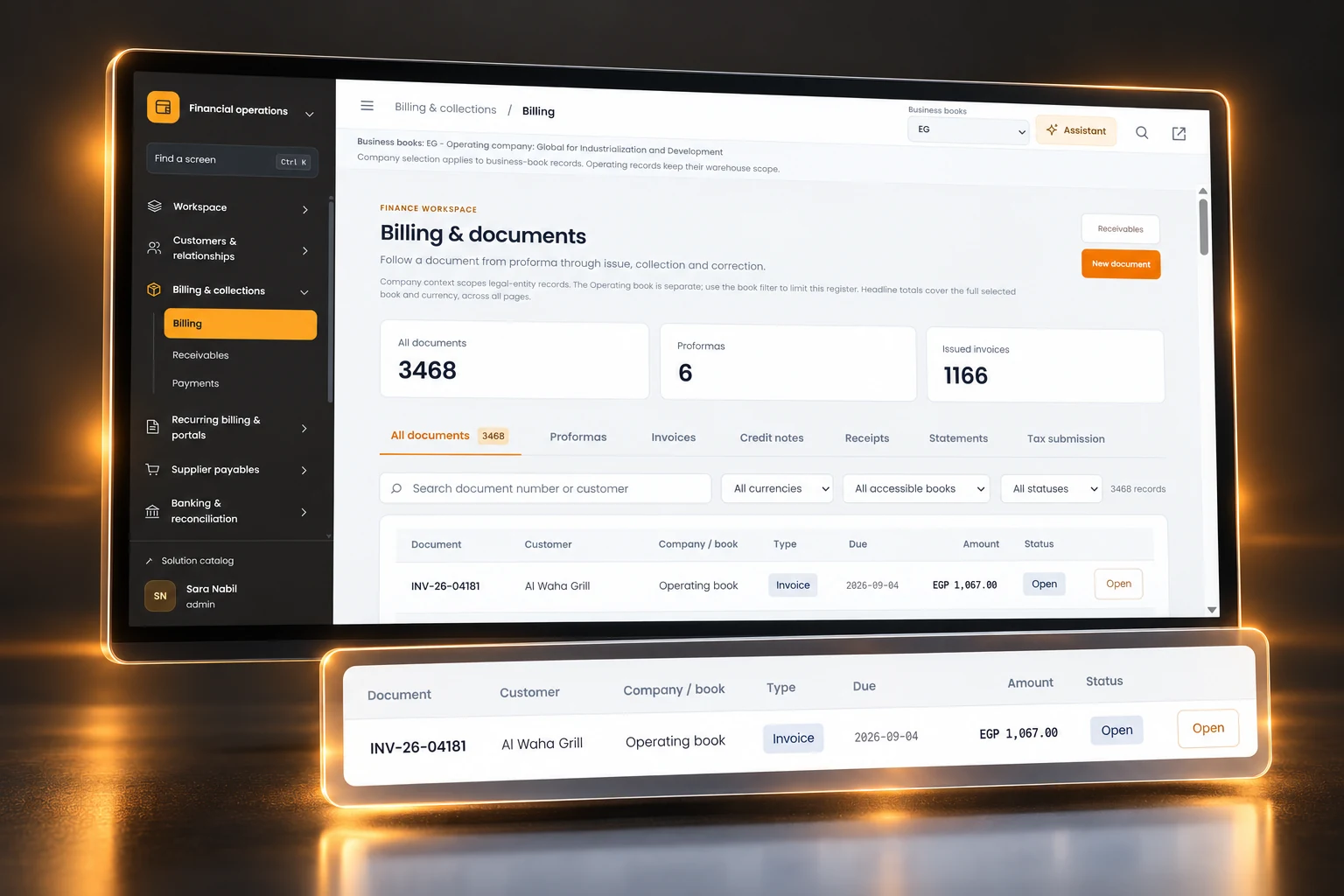
Review proformas, invoices, credit notes and receipts in a shared register. Customer, company or book, currency, due date and status stay beside the document.
Which document supports this balance, and who owns the next action?
01 / COLLECT WITH CONTEXT02 / 03
Give the collection team a reasoned priority list.
Bring invoice balances and contract milestones into one queue. Ageing and dispute context help the team focus the next customer conversation.
Who should we contact today, and what is preventing collection?
01 / COLLECT WITH CONTEXT03 / 03
Keep a reported payment distinct from confirmed money.

Inspect recorded receipts and payment references alongside unmatched funds, customer claims and unapplied credit. Allocation and confirmation remain deliberate finance actions.
Can this receipt reduce the customer balance, or does it still need evidence?
CHAPTER 02 / FINANCIAL OPERATIONS
See the obligation before money leaves the business.
Follow supplier commitments and employee claims through review, approval and the record of payment.
02 / PAY WITH CONTROL01 / 03
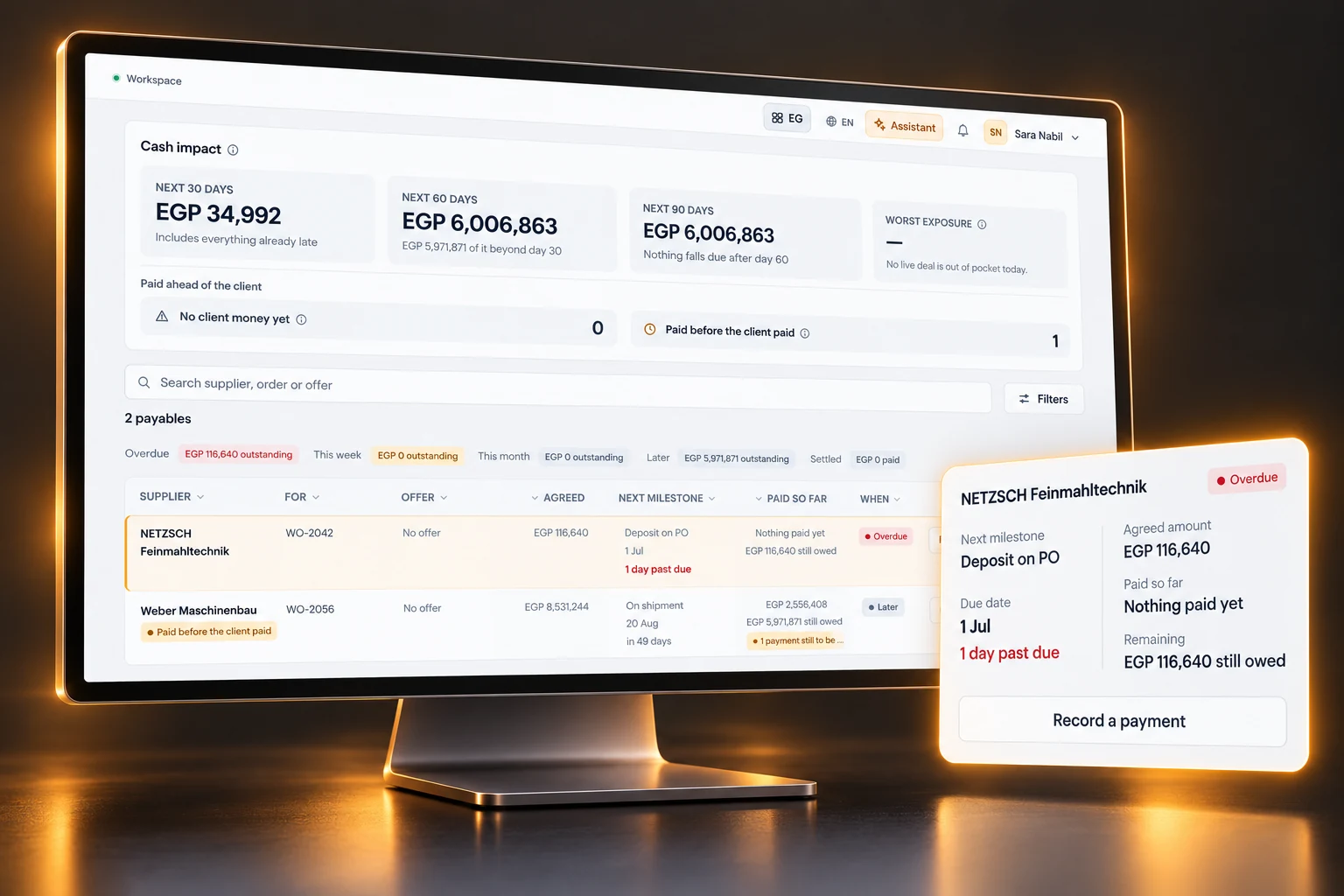
Understand what is owed before scheduling the outflow.
Review supplier obligations by when money is due to leave. Keep the offer behind the purchase order, paid amounts and remaining obligation together. See when a supplier payment falls before the related customer cash arrives.
Are we paying ahead of the customer, and what funding must we arrange?
02 / PAY WITH CONTROL02 / 03
Keep every expense connected to its evidence.

Keep a claim, its receipt and its review status in one workflow. The claimant can follow progress while finance reviews the recorded detail and supporting evidence.
Is this claim ready for a finance decision, or does it need clarification?
02 / PAY WITH CONTROL03 / 03
Separate approval from the act of paying.
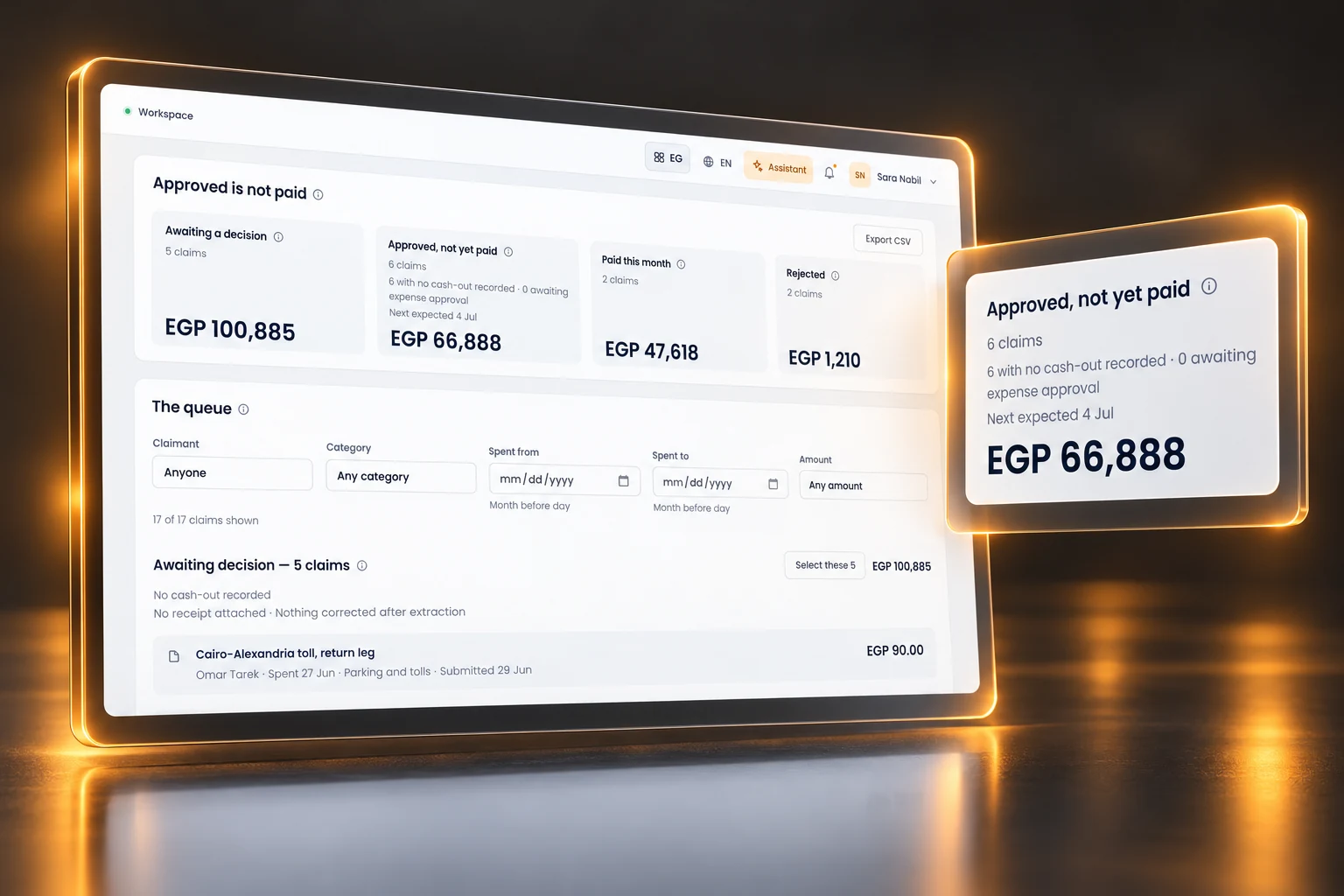
Review claims waiting for a finance decision, approved amounts still unpaid and the payment run that settles them. Keep the outcome visible to the team.
What is approved, what remains unpaid and what should enter the next run?
CHAPTER 03 / FINANCIAL OPERATIONS
Separate expected cash from recorded and confirmed movements.
Reconcile against bank evidence, review the treasury position and keep intercompany activity visible in separate books.
03 / SEE CASH CLEARLY01 / 03
See what the bank confirms and what still needs attention.
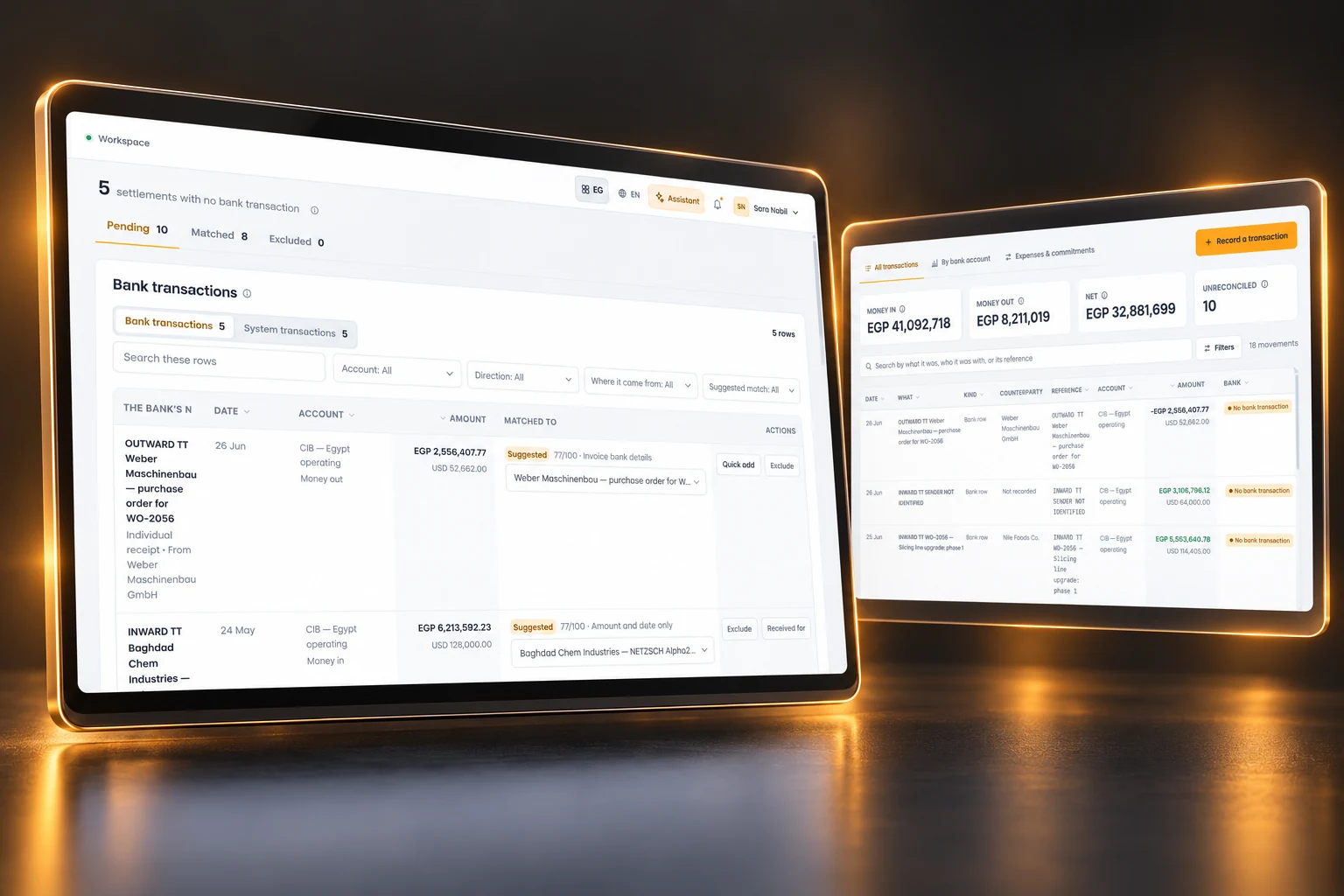
Review recorded movements by account, then compare them with statement evidence. Keep unmatched items on both sides visible and review a suggested match before linking it.
Which movements are reconciled, and which differences still require investigation?
03 / SEE CASH CLEARLY02 / 03
Make the funding conversation more concrete.
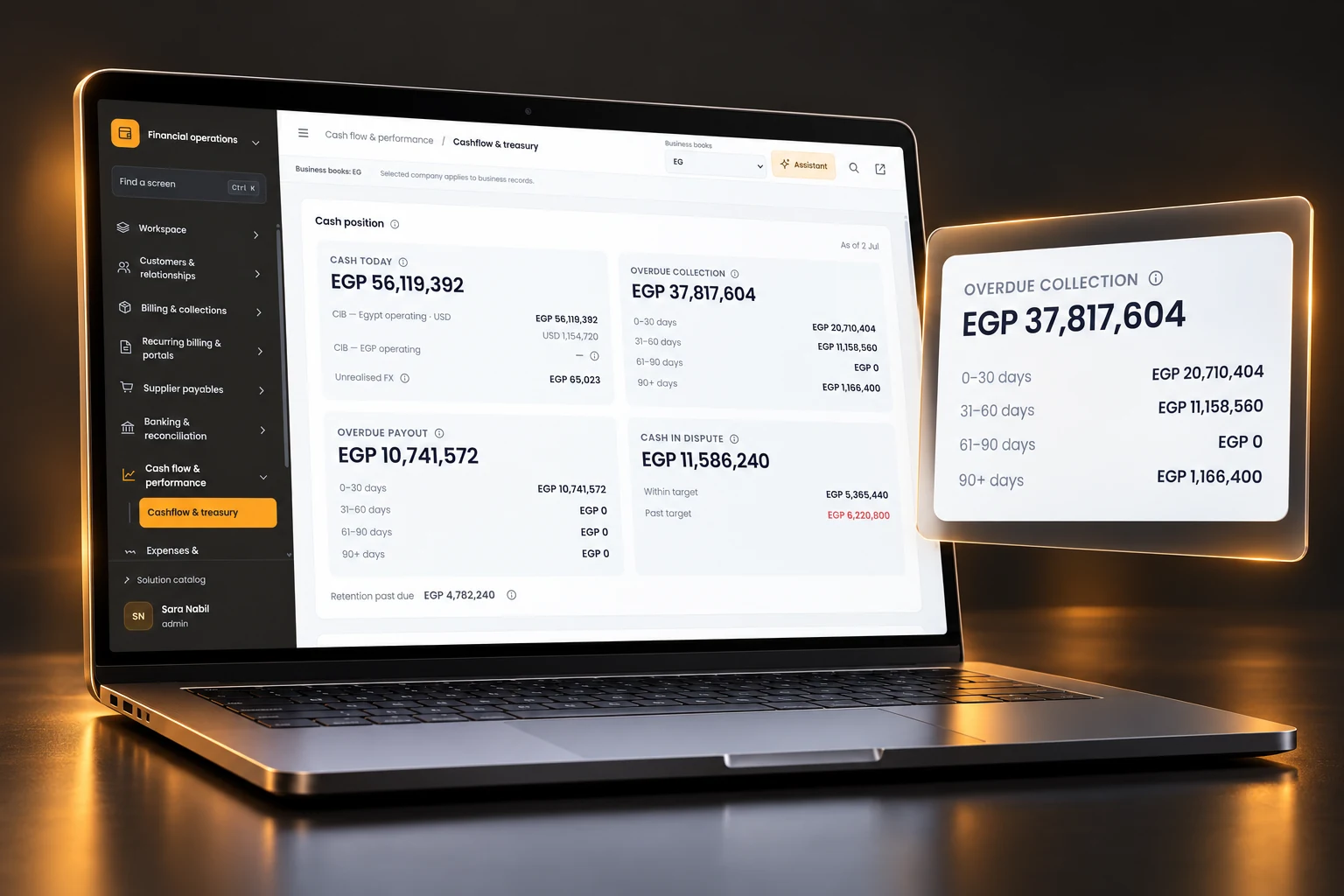
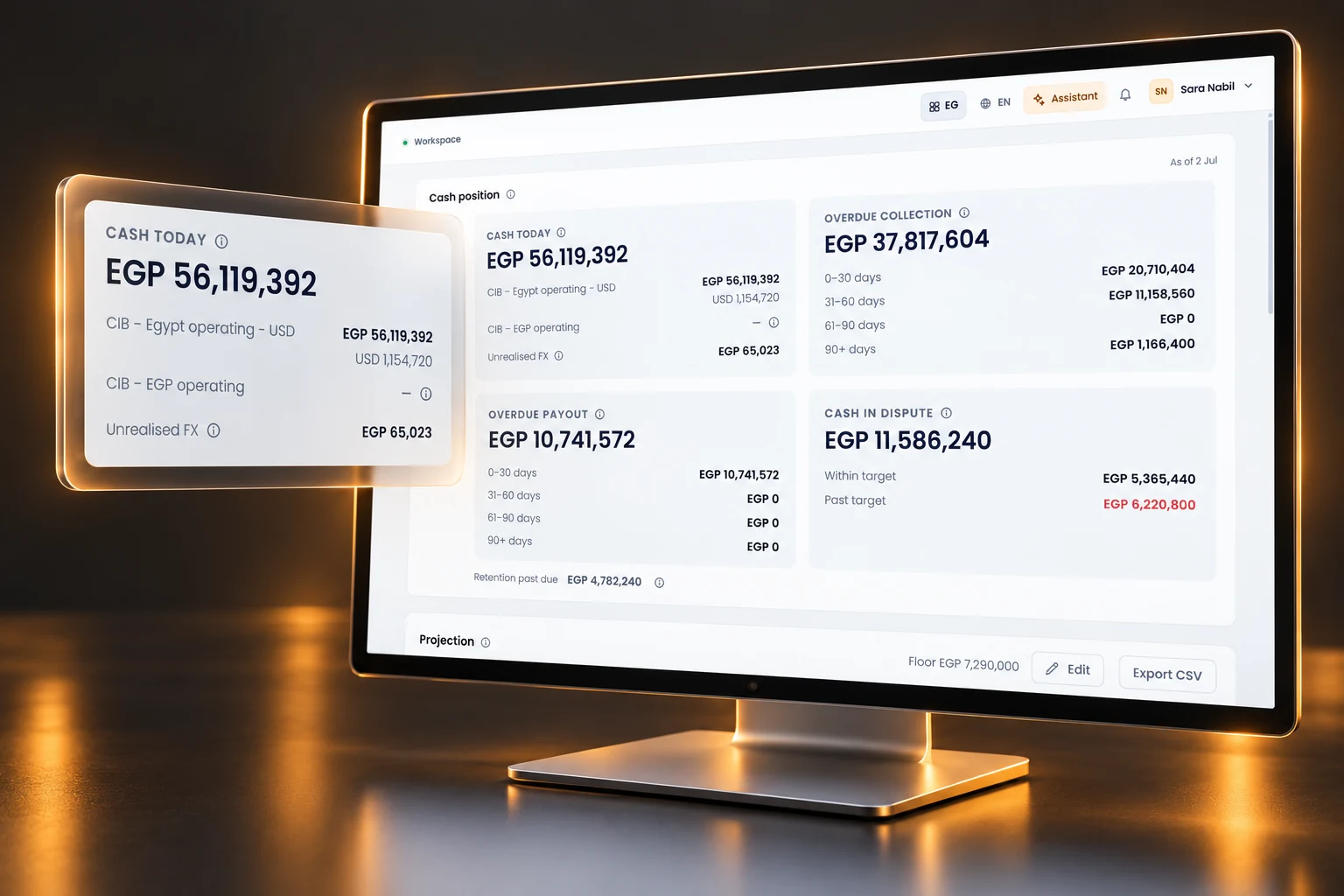
Review cash today alongside overdue collection, overdue payout and cash in dispute. Retention is included in overdue totals and shown separately from the ageing split. Review recorded history and contracted future cash in the wider cashflow view.
What can we fund now, and what depends on a collection that has not arrived?
03 / SEE CASH CLEARLY03 / 03
Keep group visibility without losing each company’s book.

Track documents, recharges and incoming items between companies. This artwork shows a cost recharge; a separate group matching view supports counterpart review. Each company keeps its own operational records.
Do the two company records agree, and what remains unresolved between them?
04 / INVOICE TO CASH
A CONCRETE, LOCAL EXAMPLEA partial payment is where control matters. Follow an illustrative EGP 120,000 invoice through an EGP 80,000 receipt and a remaining EGP 40,000 collection.
STEP 01 / ISSUE
INV-1042 is an illustrative EGP 120,000 invoice for the selected company. Its customer, due date and supporting document give collections a clear starting point.
The team can explain what is due and why.
STEP 02 / FOLLOW UP
The invoice is now overdue. The collector reviews the open amount and dispute context before following up. A customer reports an EGP 80,000 transfer; it still needs evidence.
A customer report does not become confirmed cash.
STEP 03 / RECORD
After finance verifies the credit on its own bank statement or bank portal, it records and allocates EGP 80,000 to the invoice. The EGP 40,000 shortfall remains visible for further collection.
A partial payment does not close the full balance.
STEP 04 / RECONCILE
Finance links the existing EGP 80,000 recorded movement to its statement row. Matching adds evidence to the existing receipt; it does not record another receipt. Treasury keeps the EGP 40,000 still expected distinct.
Today’s cash and tomorrow’s expectation stay distinct.
Illustrative sequence only. The amounts and dates are invented for this local example; the artwork contains separate sample UI data. No invoice is created and no payment moves.
05 / A FOCUSED FIRST SCOPE
PROVE THE WORKFLOW BEFORE EXPANDING IT.Choose one company, one priority and a representative set of records. Agree the control points before extending to more books or workflows. Leave the first scope with a workflow map, named owners, a data and connection plan, and acceptance criteria.
Confirm companies, currencies, bank accounts, record owners and the existing accounting handoff.
Review a partial receipt, an overdue supplier, a returned claim and a bank difference with the responsible team.
Confirm data quality, permissions, approval ownership, audit needs, connections and the basis for accepting the scope.
Use the workspace to coordinate money workflows and understand the cash position. Statutory accounting, tax filing and payroll remain outside the scope shown here. Bank feeds and payment execution require separate implementation confirmation.
06 / QUESTIONS FINANCE LEADERS ASK
The scope shown is operational finance: collections, obligations, expense decisions, reconciliation and treasury visibility. Agree how the approved records hand over to your existing general ledger and reporting process. Tax filing and payroll are not promised here.
The screens support statement evidence, recorded movements and matching workflows. A live feed, payment execution or provider connection is an implementation choice to confirm for your banks, markets and approval process.
Company and book context scope operational records. Intercompany documents and counterpart matching provide the group perspective. Confirm entity access, currencies, FX treatment and accounting reconciliation during discovery.
No. Expected cash depends on the terms, dates and records behind it. Recorded receipts and bank-confirmed movements remain distinct. Use the outlook to discuss timing and exposure, then review the relevant evidence.
The source workflows include scoped capabilities, finance decisions and activity/audit views. Production roles, approval thresholds, sensitive access and evidence retention must be validated against your policy during implementation.
Bring the company and currency structure, a sample collection, one supplier obligation, a claim and one statement exception. Name the record owner and the decision that currently takes too much coordination.
07 / PREPARE THE NEXT CONVERSATION
Use your brief with the presenting team to define a focused workflow,
the evidence it needs and the people who control it.